INSIGHT CONTENT OS

Turn in-house knowledge and experience into a company asset that keeps being found.

We structure the knowledge held by your leadership, sales, and engineers into research, articles, diagrams, and Webflow CMS, and build a content operation you can reuse in search, AI search, video, and sales.
We collect and edit the knowledge inside your company, and set up an operation you can reuse across articles, search, and sales.
In-house knowledge and hands-on experience
Research and primary sources
Editing, articles, diagrams
Webflow CMS and search
Video, social, sales, assessments
WHY KNOWLEDGE STAYS HIDDEN

The knowledge worth publishing is buried inside the company.

The information customers want already exists in your company. Most of it stays locked in one person's experience or in an internal document.
01
Knowledge closed inside individuals
What sales, engineering, and leadership know stays tacit.
02
Material scattered everywhere
Information sits in proposals, email, meeting decks, and PDFs.
03
Outsourced articles read as generic
Written around search terms, without understanding the industry or the customer.
04
Never reused after publishing
The article goes live and that is the end of it, never reaching video or sales material.
The problem is not writing ability. It is the absence of a procedure for gathering knowledge, checking the evidence, and editing.
COMPARISON

Accumulate knowledge people can decide on, not a count of articles.

Conventional article delivery against the Insight Content OS, where knowledge accumulates and gets reused. The same five points of comparison.
BEFORE
Conventional article production
01
Topics chosen from keywords
02
An outside writer produces generalities
03
Quality varies article by article
04
Published to the website, and done
05
Judged on page views and rankings alone
Articles that get consumed
AFTER
INSIGHT CONTENT OS
01
Designed from customer problems and management decisions
02
Edited around in-house knowledge and primary sources
03
One editorial standard and one quality bar
04
Reused in video, social, and sales material
05
Judged on contact, assessments, and meetings
Company knowledge that accumulates
THE SYSTEM

Gather the knowledge, publish it, and keep learning from the response.

In-house knowledge, external sources, Webflow, search, and sales data become one loop.
01
CAPTURE
In-house knowledge
Customer problems
02
RESEARCH
Primary sources
Citations and cases
03
EDIT
Structure and writing
Your own view
04
PUBLISH
Webflow CMS
SEO・AEO
05
DISTRIBUTE
Video and social
Sales and email
06
LEARN
Views and contact
Assessments and meetings
Published results and customer response feed back into the next topic and the next editorial decision.
EDITORIAL STRATEGY

Before deciding what to write, decide whose decision it supports.

Topics, search terms, and CTAs all work backwards from the reader's decision.
01
AUDIENCE
Who for
Owners and executives
Business unit heads
International business leads
Marketing leads
02
DECISION
What they need to decide
Where to invest first
What to keep in-house, what to send out
Risks and preparation
Choosing tools
03
ACTION
What they do next
Read a related article
Take the assessment
Look at the material
Move to a conversation
Content formats
Executive Insight
Supports a management decision
Practical Guide
Hands over a working procedure
Research / Case
Sets out the evidence and the cases
KNOWLEDGE CAPTURE

Turn tacit knowledge into material an editor can actually work with.

We collect what is already inside the company and break it into reader, problem, argument, and evidence.
Knowledge already in the company
Sales meetings
Questions from customers
How engineers explain it
Proposals and reports
Internal meetings
What failed and what was fixed
CAPTURE
EXTRACT
STRUCTURE
Converted into editorial material
The reader's problem
The central argument
Evidence and cases
Practical steps
Caveats and counterarguments
Candidate CTAs
How the knowledge is gathered
Interviews / existing material / meeting notes / recordings / FAQs / sales history

With the in-house knowledge visible, next comes building the evidence.

Hands-on experience alone will not do it, and neither will a summary of external news. We reinforce in-house knowledge with primary sources, research, and cases, and turn it into something a reader can decide on.
RESEARCH & EVIDENCE

Not introducing the news, but turning it into usable evidence.

Finding the information, corroborating it, checking counter-evidence, and drawing the implication for you — designed as separate steps.
Three stages of research
DAILY SIGNALS
RSS, official announcements, updates
WEEKLY REVIEW
Assessing candidates, sorting topics
DEEP RESEARCH
Corroboration and counter-evidence before writing
EVIDENCE LADDER
01
Official and primary sources
02
Studies, statistics, original texts
03
Corroborated across several sources
04
Japan Consulting's reading and judgment
We do not stop at external information. We add our own hands-on experience and what it means for the reader.
EDITORIAL WORKFLOW

From candidate topic to publication, every step has a person reviewing it.

AI supports the steps, but a person decides what runs, what it argues, and whether it goes live.
01
COLLECT
Gather candidates
02
SCORE
Assess
03
SELECT
Decide what runs
04
RESEARCH
Dig in and corroborate
05
EDIT
Structure and write
06
QUALITY
Quality check
07
DRAFT
CMS draft
08
PUBLISH
Final approval and publish
Where AI helps
Sorting candidates
Classifying and summarising
Draft outlines
Drafting the metadata
Where a person decides
Whether it becomes an article
The central argument
Sources and facts
Responsibility for publishing
WEBFLOW CONTENT SYSTEM

Not just the article body: search, navigation, and CTAs all managed in the CMS.

Everything needed to publish is held per article, which makes updating and reuse straightforward.
Publishing flow
Clean Markdown
Webflow CMS Draft
Human Review
Publish & Measure
What the CMS holds
ARTICLE
H1, lead, body
Key points, FAQ, quotations
DISCOVERY
SEO title and description
AEO / GEO summary
OGP, images, alt text
CONVERSION
Category and related articles
Primary / secondary CTA
Paths to assessment, enquiry, material
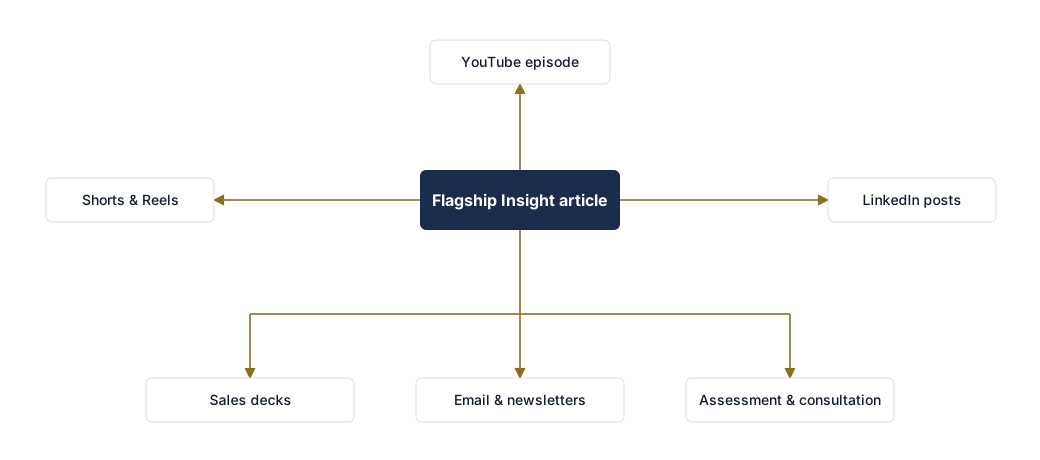
ONE SOURCE, MANY CHANNELS

Take one article and carry it across several customer touchpoints.

Not copying the same text, but re-editing it for what each channel is for.
1本の記事を起点に、理解・継続接点・営業・問い合わせへ役割を分けて展開する構成を示した図
Starting from the article, the work spreads out with distinct roles: understanding, ongoing contact, sales, and enquiries.
QUALITY & GOVERNANCE

Fast is fine, but nothing goes out that costs you credibility.

Facts, originality, value to the reader, and brand consistency come before publishing frequency.
01
READER VALUE
Value to the reader
Does it help them decide or act?
02
FACT & SOURCE
Facts and sources
Have the figures and quotations been traced to the original?
03
ORIGINAL POV
Our own view
Does it go beyond generalities to an interpretation of our own?
04
BRAND
Brand
Does it lean on exaggeration or provocation?
05
RIGHTS & PRIVACY
Rights and personal data
Have images, quotations, and customer information been handled properly?
06
HUMAN APPROVAL
Human approval
Has the person responsible signed it off?
Cleared to publish
If the bar is not met, it is revised or held rather than pushed out.

With the publishing bar settled, next comes editorial operations.

Publishing is not the end. The CMS, related articles, CTAs, and the spread into other channels are set up as one editorial operation, and the response after publishing feeds the next commission.
WHAT WE BUILD

Not article production, but editorial and CMS operations you can sustain.

Strategy, production, CMS, quality, and improvement built as one system.
01
DESIGN
Editorial design
Readers and personas
Category structure
Content formats
Topic map
CTA design
KPI design
02
BUILD
Production and CMS base
Article templates
Webflow CMS fields
Tracking sheet
Rules for diagrams and images
SEO / AEO / GEO fields
Automation workflows
03
TRANSFER
In-house handover
Editorial manual
Interview procedure
Quality checklist
Publishing approval flow
Training for your team
Monthly review
The aim is a state where you can keep commissioning, publishing, and improving without outside support.
WEEKLY OPERATING MODEL

An editorial setup a small team can run.

Not writing an article every day. Gathering, deciding, producing, and publishing run as separate steps.
MON
Mon
Gather candidates
Internal problems
External sources
Customer questions
TUE
Tue
Assess and select
Fit with the reader
Priority
Candidate CTAs
WED
Wed
Research and outline
Primary sources
Counter-evidence
Draft outline
THU
Thu
Edit and review
Body copy
Diagrams
Quality gate
FRI
Fri
Enter into the CMS
Images
SEO fields
Draft
Month end
Review search, views, navigation, assessments, and enquiries, and refine next month's topics
The days are an example, not a fixed schedule. We start at whatever cadence holds the quality — two a month, one a week, two a week.
MEASUREMENT

Not page views, but whether it led to a decision and an action.

Production, discovery, understanding, navigation, assessment, and meetings, reviewed as one flow.
01
Production indicators
Articles published
Days to produce
Pieces reused
Rounds of revision
02
Discovery and comprehension
Impressions and CTR
Views and completion
Onward to related articles
CTA clicks
03
Business indicators
Assessments started
Enquiries
Qualified meetings
Times used in sales
Learning indicators
Topics that drew response / search intent / where readers dropped off / which CTAs worked / reuse by channel
No invented figures are shown at launch. The structure allows numbers to be added once real results have built up.
IS THIS FOR YOU?

Companies this service suits

Check how you think about in-house knowledge, the purpose of publishing, quality review, and running it over time.
GOOD FIT

A good fit

You have specialist knowledge and hands-on experience in-house
Your leadership can take part in the editing
You want to explain complex B2B subjects
You want the articles to work in sales too
You want to make use of Webflow CMS
You want the editorial know-how to stay in-house
An editorial base where knowledge accumulates
NOT A FIT

Not a good fit

×
You want a large volume published in a short time
×
Search rankings are the only goal
×
You only want to post summaries of other people's articles
×
You do not want to review anything internally
×
You want it fully outsourced, permanently
×
You judge it on the number of articles
Article production measured by count
IMPLEMENTATION

Test the editorial standard on two to five pieces, settle the routine, then widen it.

We design the starting point around your existing articles, internal material, CMS, and the people available.
01
AUDIT
About 2 weeks
02
DESIGN
2–4 weeks
03
BUILD
2–4 weeks
04
PILOT
4–8 weeks
05
TRANSFER
Ongoing
Timings are indicative, not fixed pricing. Keeping the pilot as its own phase avoids forcing a full rollout.
FAQ

Questions we are asked before starting

On the editorial setup, use of AI, Webflow CMS, and existing articles.

Q1. Can we do this without a writer in-house?

Yes. We handle the planning and the writing, and you review. The specialist knowledge exists only inside your company, so we draw it out in interviews and turn it into articles. The design assumes that writing, too, moves in-house over time.

Q2. Is this a service that generates articles with AI?

We move towards automated generation in stages. But the tone, the structure, the audience, and the vocabulary are designed first, and generation follows that standard. Designing and adjusting takes around three months to settle. The principle that a person reviews before publication does not change.

Q3. Can our existing blog articles be reused?

Yes. We take stock first and sort them into what to extend, what to merge, and what to write fresh. Published articles already carry standing, so they sometimes reach results faster than new ones.

Q4. Can we commission SEO articles only?

You can. But aiming only at search traffic tends to produce articles that get read and lead nowhere. We recommend starting from the questions you are actually asked in meetings, and layering search demand on top of that.

Q5. Does this work with WordPress or another CMS?

Yes. For WordPress and other systems we prepare and deliver the content ready to be entered. There is no need to rebuild your current site.

Q6. Does the scope include entering articles into Webflow CMS?

Yes. Body copy, headings, diagrams, metadata, and internal links all come in already entered. All that is left to you is the decision to publish.

Q7. How many articles a month do you produce?

Three a week at minimum, five a week ideally. Volume matters because search takes time to respond, and because which questions turn out to have demand only becomes clear once you publish. Putting out a steady number, watching the response, and going deeper on what grows is the most reliable route.

Q8. Can articles be carried into YouTube and social?

Yes. A YouTube video is produced from the article, and short clips from it are reused as Instagram carousels and TikTok. One argument produces several touchpoints, which takes less work than planning each separately.

Q9. How many hours a week does it take on your side?

Five to ten hours a week: reviewing the plan, checking the copy, and answering interview questions on the technical content. We write and enter the articles, so your work is mostly review.

Q10. Does the scope include analysis and improvement after publishing?

Yes. Working from GA4 and Search Console, we review each month which articles grew and which need work. The test is whether they led to an enquiry or a download, not page views.

Q11. Are blog articles the only thing you handle?

No. Reports, white papers, technical explainers, and formal external documents can all be produced on the same design and vocabulary. Once the tone and structure are set, the wording holds even as you widen the range.

Q12. Do we have to disclose that AI was used?

That is your decision. Either way, we document the tools used and the human review steps and hand that over. Japan Consulting publishes its own AI transparency policy, and we can prepare one in the same form.
START WITH CLARITY

Before writing articles, sort out the knowledge and material you already have.

We review your existing articles, material, customer questions, CMS, and available people, and make the priorities clear.
Article and CMS assessment
A quick review of your current articles, material, CMS, and editorial setup.
Assess your articles and CMS
A design conversation
We work out how to approach Insight, Webflow, SEO, and running it in-house.
Talk through editorial operations
This is not a conversation about publishing more articles. It is about keeping knowledge and judgement criteria inside your company.
Start with one question.
Tell us what you are trying to decide — a supplier you need assessed, or marketing you are trying to bring in-house. You get a written reply within one business day, at no cost and no obligation.